Noul tip de nanomateriale de carbon de inginerie este capabil să schimbe forme și culori.Astfel de materiale au atras atenția datorită proprietăților și structurilor optice unice.
Oamenii de stiinta de la Institutul de Tehnologie de la Tokyo au produs materiale 1-aril 1,3-difosfaciclobutan-2,4-diil stationar prin arilare directa cu substituenti aromatici bogati in electroni. Această metodă permite reglarea fină a proprietăților electronice ale unor astfel de compuși heterociclii fosforici pentru aplicații care includ fabricarea de senzori electronici organici și fluorură de fluor.ar putea permite detectarea vizuală a existenței HF și ar putea fi utilizată pentru dezvoltarea senzorilor HF.
Posted: May 10, 2016
Fine tuning phosphorous heterocycle materials for organic electronics
(Nanowerk News) Scientists at Tokyo Institute of Technology have produced airstable 1-aryl 1,3-diphosphacyclobutane-2,4-diyl materials by direct arylation with electron rich aromatic substituents. This method enables the fine tuning of the electronic properties of such phosphorous heterocycles compounds for applications including fabrication of organic electronics and hydrogen fluoride sensors (Angew. Chem. Int. Ed., „Access to Air-Stable 1,3-Diphosphacyclobutane-2,4-diyls by an Arylation Reaction with Arynes”).
Materials scientists have a strong interest in the development of methods for the synthesis of so-called ‘open-shell singlet P-heterocyclic’ materials systems for applications in the organic electronics industry including organically based sensors and optoelectronic devices. Here, Shigekazu Ito and colleagues at School of Materials and Chemical Technology, Tokyo Institute of Technology report on a new method for the production of airstable 1-aryl 1,3-diphosphacyclobutane-2,4-diyls— an open-shell singlet P-heterocyclic’ materials system—by direct arylation with electron rich aromatic substituents. This ability to tune the physiochemical nature of the electron-donating 1-aryl 1,3-diphosphacyclobutane-2,4-diyls is expected to find applications including p-type semiconductors and sensors of hydrogen fluoride.
Reversible change of color via the hydrofluorination process.
Background
The Tokyo Tech group have previously reported on a nucleophilic aromatic substitution (SNAr) process for producing air-stable 1-aryl 1,3-diphosphacyclobutane-2,4-diyls. However, this method only worked in the case of electron-deficient N-heterocyclic aryl halides were employed as the electrophiles. Hence, there is still the need for new approaches for direct arylation of 1,3-diphosphacyclobuten-4-yl anions with electron rich aromatic substituents that produce electron-donating and stable 1,3-diphosphacyclobutane-2,4-diyls for organic electronics.
Details
The method developed by the Tokyo Tech group is based on the assumption that, “highly electrophilic arynes should react with and afford stable and electron-donating openshell singlet P-heterocycles.” In their experiments, the researchers generated arynes from the appropriate o-silyl triflates and fluoride, observed them to react with 1,3-diphosphacyclobuten-4-yl anion under appropriate conditions with the result being air-stable open-shell singlet P-heterocycles.
Notably, during the experiments the researchers also detected the presence of hydrogen fluoride (HF) by the P-arylated 1,3 diphosphacyclobutane-2,4-diyls. This release of HF resulted in remarkable changes in their photoabsorption properties. Analysis showed that 1,3 diphosphacyclobutane-2,4-diyls absorbed visible light at approximately 600 nm. Futhermore, the researchers fabricated a field effect transistor with a carrier mobility of 1.29x 108 cm2/ Vs, ON/OFF ratio of 6, and threshold voltage of 4 V.
The Tokyo Tech group also found the optical absorption to show a ‘blue shift’ when the open-shell P-heterocyclic system ‘trapped’ hydrogen fluoride (HF); a finding that may enable the visual detection of the existence of HF, and could be used for the development of HF sensors.
The researcherse state: “In our study of HF trapping by the open-shell P-heterocyclic system, the electron-rich 1,3-diphosphacyclobutane-2,4-diyl system showed a remarkable blueshift of photoabsorption assigned as the transition from the HOMO to the LUMO, which enabled the identification of the presence of HF by visual observation.”
A venit timpul să înlocuiți siliciul utilizat în mod tradițional cu cerneluri tipografice organice semiconductoare.Oamenii de știință cred că acest lucru, în special pentru viitoarele electronice care trebuie să fie flexibile, ușor, ușor de purtat și cu costuri reduse
un nou tip de fir compozit care variază în funcție de rigiditate, în funcție de temperatura acestuia. Aplicațiile variază de la roboți multifuncționali până la turnări tricotate și chiar dispozitive medicale tunabile
indicând grafenul întins înainte de rupere, care ar trebui să fie promițător, deoarece arată că energia microbulletului este distribuită pe o arie largă a materialului de grafen, în ciuda puncției
a demonstrat un sistem cu câteva componente de interacțiune a speciilor organice care, atunci când sunt combinate într-o rețea de reacție, au prezentat caracteristici autocatalitice și oscilante
Noul material se bazează pe fibrele din polimeri goi tratați pentru a-și păstra structura – și dimensiunile porilor – deoarece sunt transformate în carbon prin piroliză. Membranele de carbon sunt apoi utilizate într-un nou procedeu de „osmoză inversă cu solvent organic” (OSRO) în care se aplică presiune pentru a efectua separarea fără a necesita o schimbare de fază a amestecului chimic.Fibrele de carbon goale, grupate împreună în module, pot separa molecule ale căror dimensiuni diferă cu o fracțiune de nanometru, oferind în același timp rate de prelucrare superioare celor ale zeolitilor de sită moleculară existente.
Posted: Aug 19, 2016
Carbon molecular sieve membranes could cut energy in hydrocarbon separations (w/video)
(Nanowerk News) A research team from the Georgia Institute of Technology and ExxonMobil has demonstrated a new carbon-based molecular sieve membrane that could dramatically reduce the energy required to separate a class of hydrocarbon molecules known as alkyl aromatics. The new material is based on polymer hollow fibers treated to retain their structure – and pore sizes – as they are converted to carbon through pyrolysis. The carbon membranes are then used in a new „organic solvent reverse osmosis” (OSRO) process in which pressure is applied to effect the separation without requiring a phase change in the chemical mixture.
The hollow carbon fibers, bundled together into modules, can separate molecules whose sizes differ by a fraction of a nanometer while providing processing rates superior to those of existing molecular sieve zeolites. Because it uses a commercial polymer precursor, the researchers believe the new membrane has potential for commercialization and integration into industrial chemical separation processes. The research will be reported in the August 19 issue of the journal Science(„Reverse Osmosis Molecular Differentiation of Organic Liquids using Carbon Molecular Sieve Membranes „).
Separation is currently achieved through refining processes such as crystallization and adsorption with distillation, which are energy-intensive. Globally, the amount of energy used in conventional separation processes for alkyl aromatics is equal to that produced by about 20 average-sized power plants.
„We see this as a potentially disruptive technology in the way we separate xylenes and similar organic compounds,” said Benjamin McCool, one of the paper’s co-authors and an advanced research associate at ExxonMobil Corporate Strategic Research in Annandale, N.J. „If we can make this work on an industrial scale, it could dramatically reduce the energy required by these separation processes.”
A research team from the Georgia Institute of Technology and ExxonMobil has demonstrated a new carbon-based molecular sieve membrane that could dramatically reduce the energy required to separate a class of hydrocarbon molecules known as alkyl aromatics. The new material is based on polymer hollow fibers treated to retain their structure – and pore sizes – as they are converted to carbon through pyrolysis. The carbon membranes are then used in a new “organic solvent reverse osmosis” (OSRO) process in which pressure is applied to effect the separation without requiring a phase change in the chemical mixture.
Fabrication of the new membrane material begins with hollow polymer fibers approximately 200 microns in diameter, slightly thicker than the average human hair. The fibers have pore sizes of less than one nanometer, and are treated via cross-linking before they are converted to carbon through a pyrolysis process. The pore sizes of the fibers can be adjusted during the fabrication process.
„We take a scalable platform based on polymeric membranes and then turn those materials into inorganic molecular sieves,” explained Ryan Lively, an assistant professor in Georgia Tech’s School of Chemical & Biomolecular Engineering and the paper’s corresponding author. „Our membranes are mechanically robust and they can withstand the process conditions required by OSRO. They maintain advantageous mechanical properties and membrane performance as they are converted to carbon fiber.”
Lively and postdoctoral fellow Dong-Yeun Koh used the OSRO process in the laboratory to separate mixtures of para-xylene and ortho-xylene, molecules whose sizes differ by one-tenth of a nanometer. By applying pressure at room temperature, the membrane can convert the 50-50 mixture to an 85-15 mixture at a high flux relative to zeolite membranes.
Georgia Tech Assistant Professor Ryan Lively (left) and Postdoctoral Fellow Dong-Yeun Koh hold bundles of hollow polymer fibers that serve as precursors for the carbon membrane fiber used to separate alkyl aromatic chemicals.
„These molecules have incredibly similar sizes and properties, but the membranes can tell them apart,” said Lively. „This bulk cut of the mixture greatly enhances the concentration with a very low energy input. This mixture could then be fed into a conventional thermal process for finishing, which would reduce the total energy input dramatically.”
In industrial use, the membranes would be bundled together in modules that would be used in chemical facilities. „In practice, you would get as many modules as you needed for a particular application, and if the need increased, you could simply add more modules,” Lively said. „It would be totally scalable.”
Reverse osmosis membranes are already widely used in desalination to produce drinking water from saltwater, consuming a fraction of the energy required by thermally-driven process. Carbon fiber membranes are being used for gas separations, but the new OSRO process is believed to be the first use of reverse osmosis with carbon membranes to separate liquid hydrocarbons.
Though the membrane has demonstrated promising results, it still faces a number of challenges. The membranes will have to be tested with more difficult separations before they can be considered for commercialization and scale-up. Industrial mixtures normally contain multiple different organic compounds, and they may include materials that can foul membrane systems. The researchers will also have to learn to make the material consistently and demonstrate that it can withstand long-term industrial use.
„Because we are starting with commercially-available polymers and we are using commercial-type equipment, we can see a clear line-of-sight to commercialization with this technology,” McCool said. „It’s a big advantage that the membranes are being spun on a hollow-fiber line similar to that currently used in the industry. The time horizon to make this happen and the cost of production could be highly advantaged over other inorganic systems or more exotic materials like graphene.”
Source: By John Toon, Georgia Institute of Technology
Un material nanocristalin care face rapid lumina alba din lumina albastra a fost dezvoltat de cercetatorii KAUST pentru iluminarea combinată și comunicarea de date.
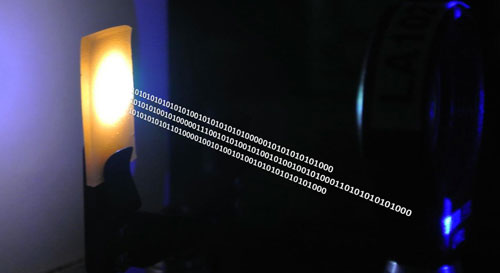
A nanocrystal-based material converts blue laser emission to white light for combined illumination and data communication. (Image: KAUST)
While Wi-Fi and Bluetooth are now well established technologies, there are several advantages gained by shortening the wavelength of the electromagnetic waves used for transmitting information.
So-called visible-light communication (VLC) makes use of parts of the electromagnetic spectrum that are unregulated and is potentially more energy-efficient. VCL also offers a way to combine information transmission with illumination and display technologies–for example, using ceiling lights to provide internet connections to laptops.
Many such VLC applications require light-emitting diodes (LEDs) that produce white light. These are usually fabricated by combining a diode that emits blue light with phosphorous that turns some of this radiation into red and green light. However, this conversion process is not fast enough to match the speed at which the LED can be switched on and off.
„VLC using white light generated in this way is limited to about one hundred million bits per second,” said KAUST Professor of Electrical Engineering Boon Ooi.
Instead, Ooi, , Associate Professor Osman Bakr and their colleagues use a nanocrystal-based converter that enables much higher data rates.
The team created nanocrystals of cesium lead bromide that were roughly eight nanometers in size using a simple and cost-effective solution-based method that incorporated a conventional nitride phosphor. When illuminated by a blue laser light, the nanocrystals emitted green light while the nitride emitted red light. Together, these combined to create a warm white light.
The researchers characterized the optical properties of their material using a technique known as femtosecond transient spectroscopy. They were able to show that the optical processes in cesium lead bromide nanocrystals occur on a time-scale of roughly seven nanoseconds. This meant they could modulate the optical emission at a frequency of 491 Megahertz, 40 times faster than is possible using phosphorus, and transmit data at a rate of two billion bits per second.
„The rapid response is partly due to the size of the crystals,” said Bakr. „Spatial confinement makes it more likely that the electron will recombine with a hole and emit a photon.”
Importantly, the white light generated using their perovskite nanostructures was of a quality comparable to present LED technology.
„We believe that white light generated using semiconductor lasers will one day replace the LED white-light bulbs for energy-efficient lighting,” said Ooi.
Source: King Abdullah University of Science & Technology
au descoperit un nou tip de semimetal Weyl, un material care deschide calea pentru studiul în continuare a fermiunilor Weyl, un tip de particule elementare fără masa, ipotezat de teoria particulelor de energie înaltă și potențial util pentru crearea de circuite electronice de mare viteză și computere cuantice.Cercetătorii au creat un cristal de molibden și telur, unul dintre puținele compuși care se presupune că găzduiesc un tip nou de Weyl, postulat, în care benzile electronice și electronice se separă în mod normal printr-o atingere indirectă la câteva puncte Weyl. Aceste puncte sunt echivalente cu monopolurile magnetice din spațiul de impuls și sunt conectate prin arce Fermi.
Posted: Aug 15, 2016
New material discovery allows study of elusive Weyl fermion
(Nanowerk News) Researchers at the U.S. Department of Energy’s Ames Laboratory have discovered a new type of Weyl semimetal, a material that opens the way for further study of Weyl fermions, a type of massless elementary particle hypothesized by high-energy particle theory and potentially useful for creating high-speed electronic circuits and quantum computers (Nature Materials, „Spectroscopic evidence for a type II Weyl semimetallic state in MoTe2„).
Researchers created a crystal of molybdenum and tellurium, one of only a few compounds that had been predicted to host a new and recently postulated type of Weyl state, where the hole and electron bands normally separated by an indirect gap touch at a few Weyl points. Those points are equivalent to magnetic monopoles in the momentum space and are connected by Fermi arcs.
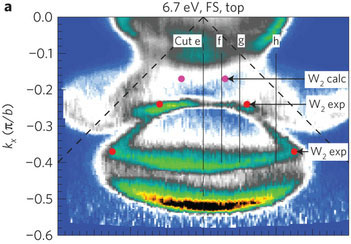
A combination of angle resolved photoemission spectroscopy (ARPES), modelling, density functional theory and careful calculations were used to confirm the existence of this new type of Weyl semimetal.
This material provides an exciting new platform to study the properties of Weyl fermions, and may lead the way to more new materials with unusual transport properties.
„This an important, interdisciplinary discovery because it allows us to study many aspects of these exotic particles predicted by high energy physics theory in solid state, without need for extremely expensive particle accelerators,” said Adam Kaminsky, Ames Laboratory scientist and professor in the Department of Physics and Astronomy at Iowa State University. „From my perspective as solid state physicist it is absolutely extraordinary to observe two bands touching each other at certain points and being connected by Fermi arcs – objects that are prohibited to exist in „ordinary” materials.”